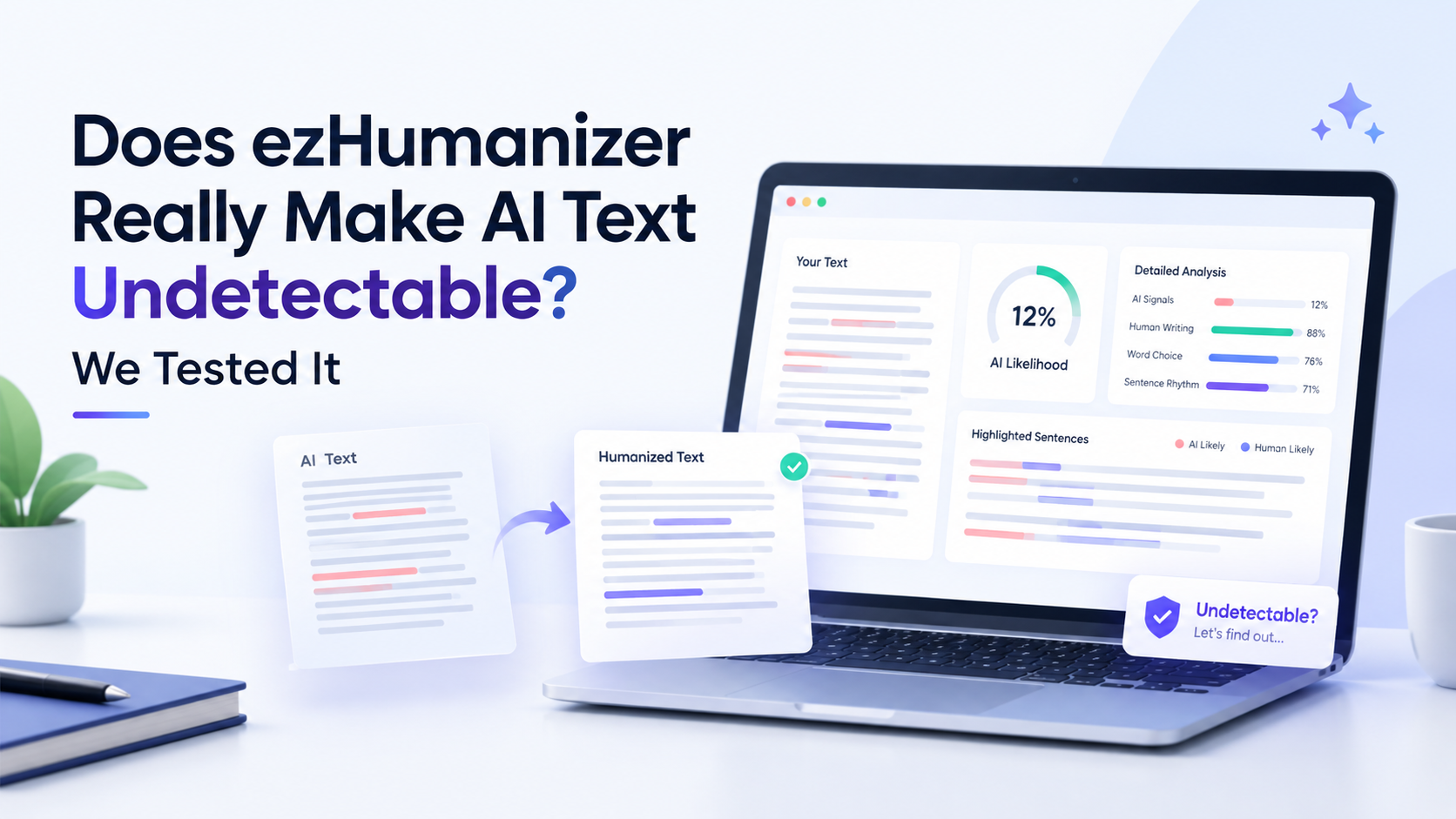
Every AI humanizer on the market claims it can make AI-generated text “undetectable”.
It’s an easy claim to make. But it’s a hard one to verify unless you actually run the test yourself. So, that’s exactly what we did in the case of ezHumanizer.
We generated raw AI text with ChatGPT and processed it through the humanizer. Then, we checked the tool’s output for AI detection using a few popular AI detectors.
Below, you’ll find screenshots of every result, the analysis of output quality, and most importantly, the answer to the main question: “Does ezHumanizer make AI content undetectable?”
What is ezHumanizer?
ezHumanizer is an AI humanizer tool that makes robotic/machine generated content sound more human. It takes the AI text, processes it, and returns a humanized version of the input.
It claims to provide outputs that score as human-written on AI detectors.
The tool uses two different modes for humanizing: basic and advanced. The basic mode is free to use, while the advanced mode can only be accessed through a paid subscription.
It allows 700 words as input in the free mode, and 2500 words per input in the premium version.
The idea behind most of these tools is simple. AI detectors look for patterns that are common in AI writing, e.g., perfectly uniform sentence lengths, predictable word choices, and a generic smoothness.
So, a humanizer breaks those patterns to make it harder to detect.
How We Tested It
Rather than just relying on a single check, we decided to carry out three different tests with varied inputs. We used a blog style paragraph, an academic paragraph, and a longer informational passage, all generated with ChatGPT.
After humanizing each one through ezHumanizer, we scanned them for AI detection using three separate detectors:
ZeroGPT
Copyleaks
Quillbot
Looking at the detector percentages was just one side of the picture. We also did some important quality checks. Those checks helped us identify whether the original context of the text was preserved and how the humanizer changed the wording and structure of AI text.
All the testing details and results are given below.
Test 1: Blog Style Paragraph
For the first test, we generated a blog style paragraph of around 120 words with the help of ChatGPT:
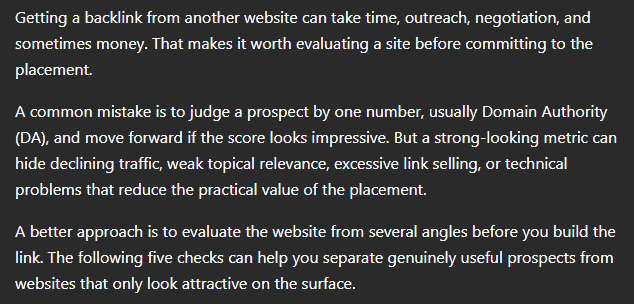
This raw AI text was then run through the AI humanizer using its basic mode:
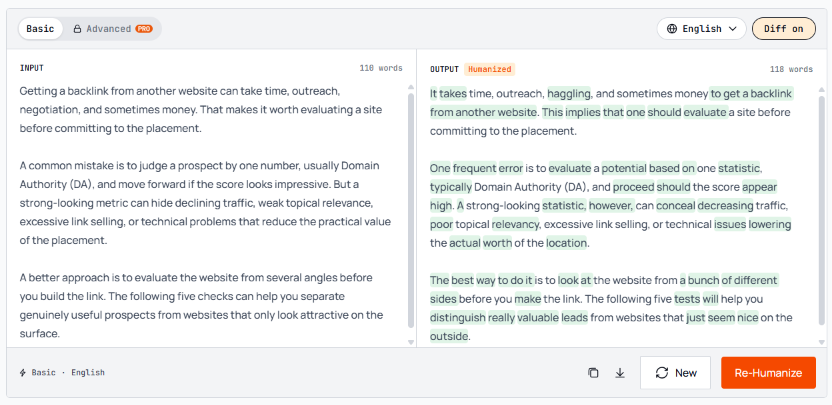
The change in voice and rhythm was noticeable in the humanized text. Stiff line closings of the AI text became more natural. The phrasing was a bit casual and uneven, which made it feel closer to how a human would write.
We copied the tool’s output and scanned it through the AI detectors. Here are the results.
ZeroGPT:
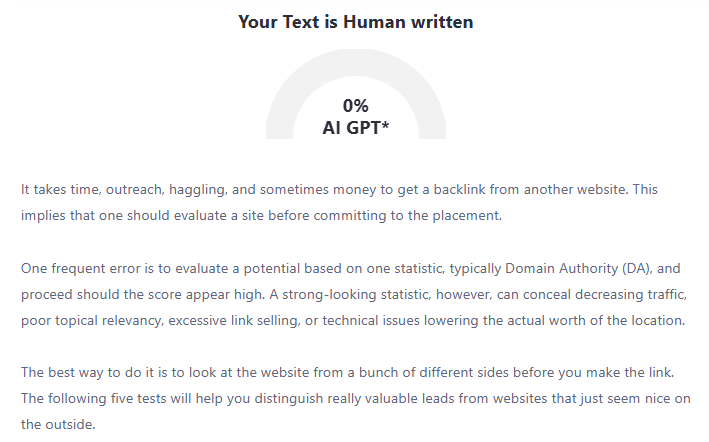
Copyleaks:
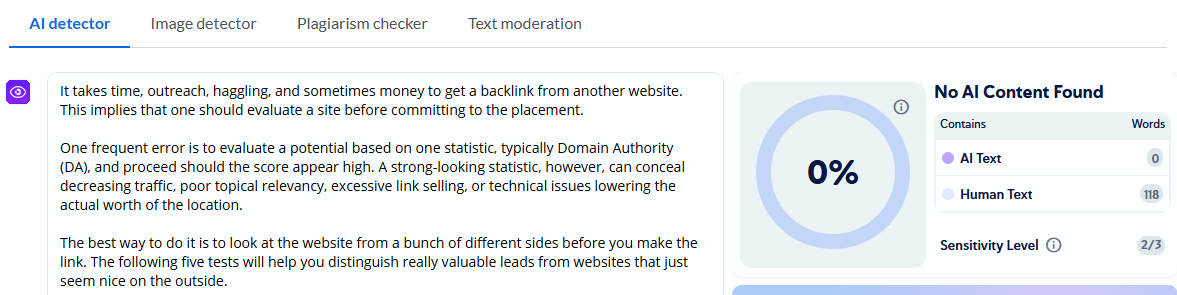
Quillbot:
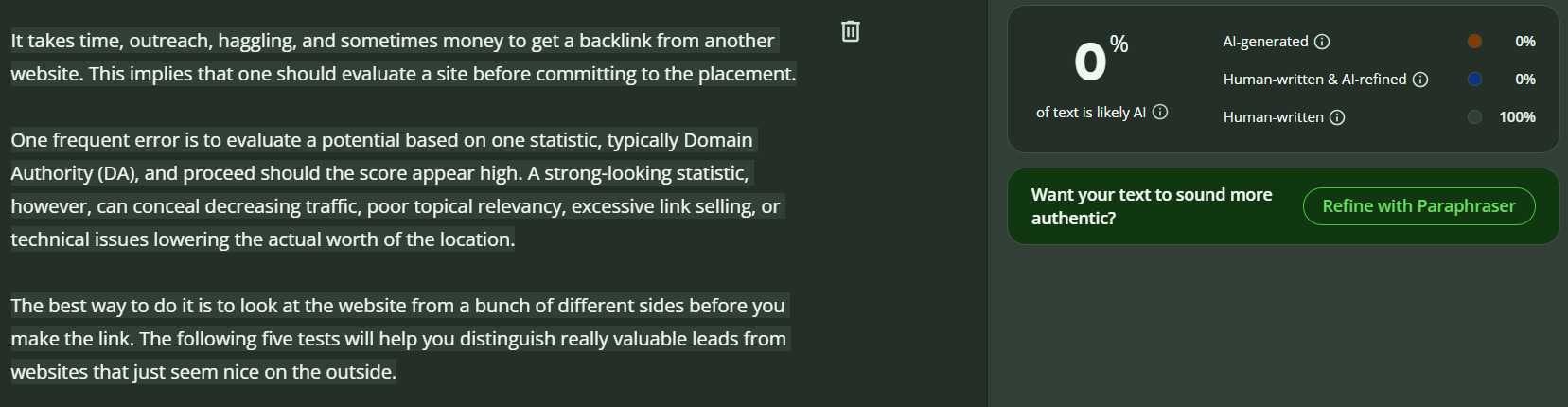
For the first test, the results were uniform across all three detectors: 0% AI detected.
Although the tool’s output bypassed the detectors, it’s important to keep an eye on a few phrases that feel informal, i.e., "a bunch of different sides". For blog content, you may need to adjust such instances and make them sound more professional.
Test 2: Academic Paragraph
Next, we decided to try something more formal. This is a style where detectors tend to be a bit more strict and where awkward terms in the humanizer’s output would become more noticeable. So we generated an academic paragraph using ChatGPT:

This time we went with the “Advanced” mode for humanizing:
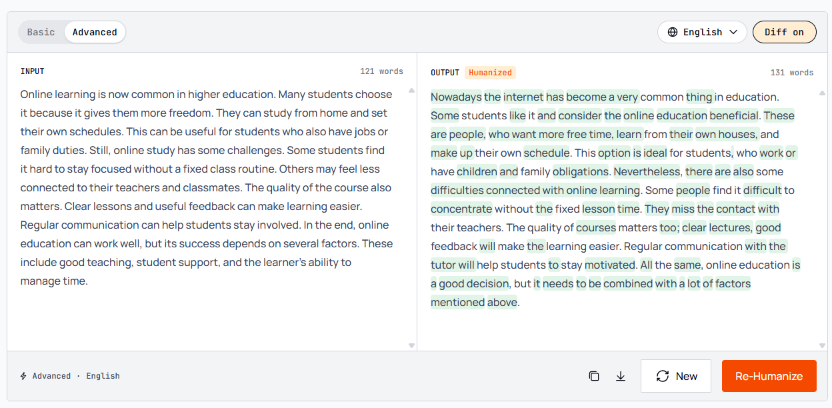
The restructuring here feels aggressive compared to Test 1. And this makes sense. The tool worked harder to break up the dense and uniform rhythm of academic writing. Sentences were reordered and rephrased. A few stylistic changes were also apparent.
The humanized text was then scanned through the three AI detectors.
ZeroGPT:
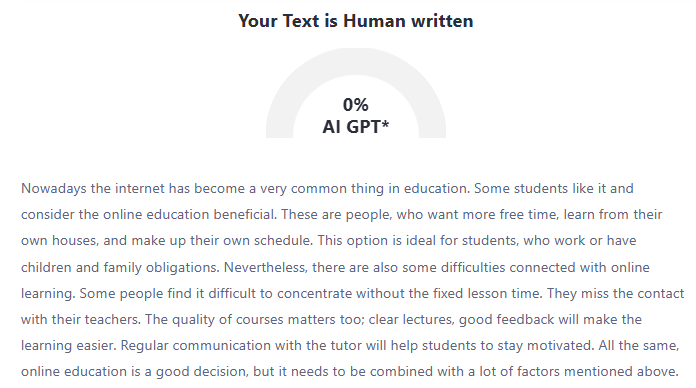
Copyleaks:
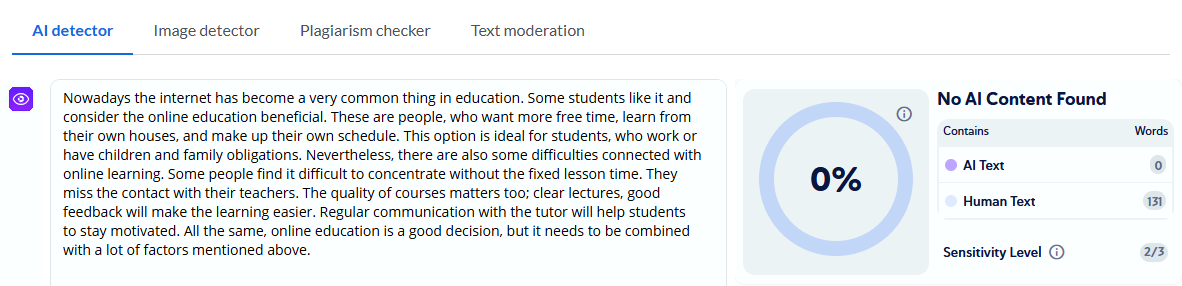
Quillbot:
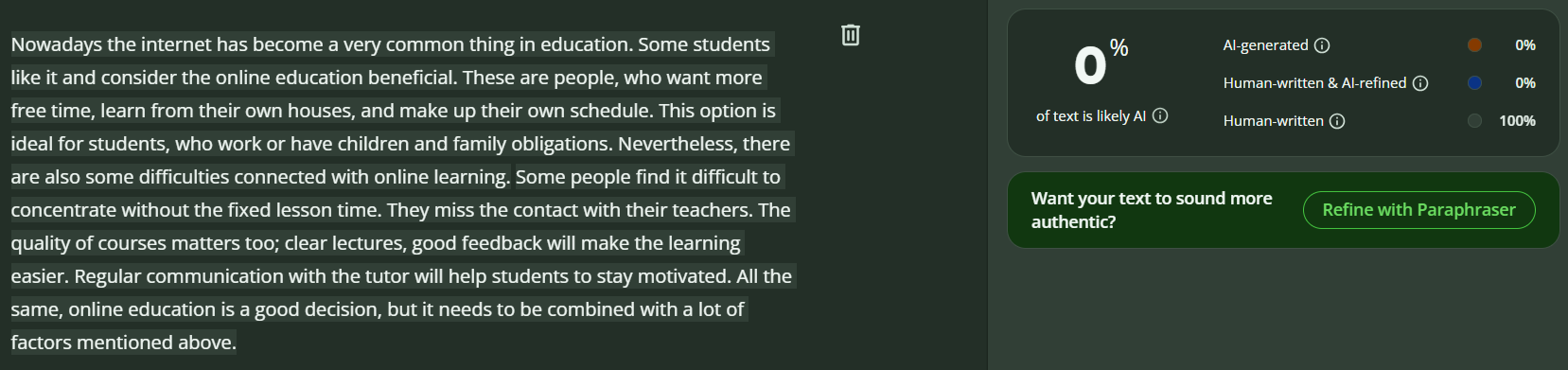
The results were still consistent, and none of the content was detected as AI.
It’s fair to say that the humanizer did its job in bypassing the detectors and preserving the original message of the text. The output was also grammatically clean.
However, academic writing is where you’d want to spend some extra seconds reading the output carefully. You might need to adjust a couple of conversational phrases that slightly drift from the uniform and formal tone of the academic text.
Also, it would be wise to double-check the entities, as they often hold most of the context. Even a slight change in such terms may totally change the intended meaning of the text.
Test 3: Longer Informational Passage
For the last and toughest test, we asked ChatGPT to generate a longer passage.
It contained dense information with multiple conceptual points. That’s exactly the type of structured content where many humanizers often lose the thread or flatten important nuance.
The length of the text was around 400 words:
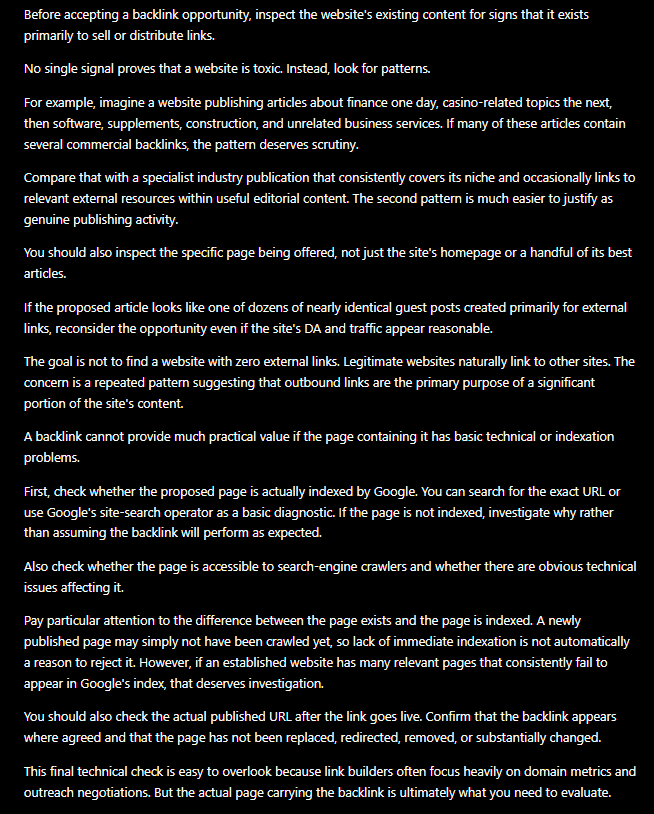
We copied this exact AI text and ran it through the humanizer. This time we went with the basic mode:
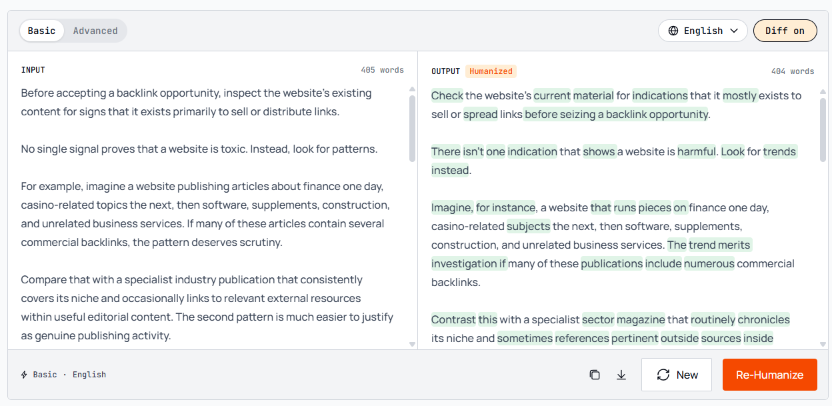
From the output, it was visible that the tool maintained the paragraph structure and logical order of the ideas. The technical points, for example, “page exists vs. page indexed,” stayed intact. Vocabulary was changed in several places, and the meaning was mostly preserved throughout the text.
Then came the important part. We ran the humanized version through the same AI detectors one by one.
ZeroGPT:
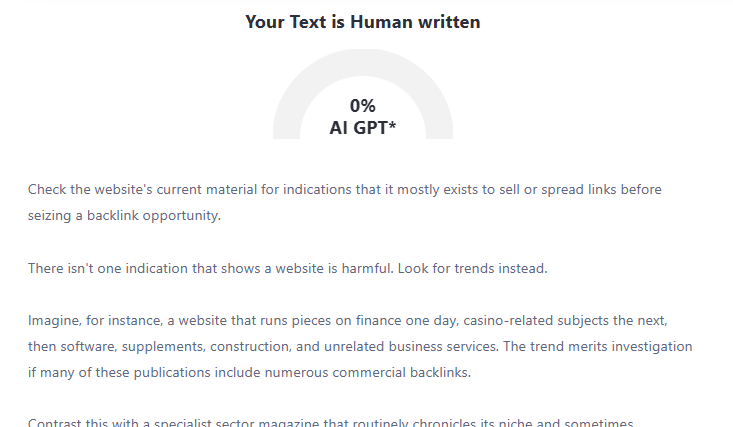
Copyleaks:
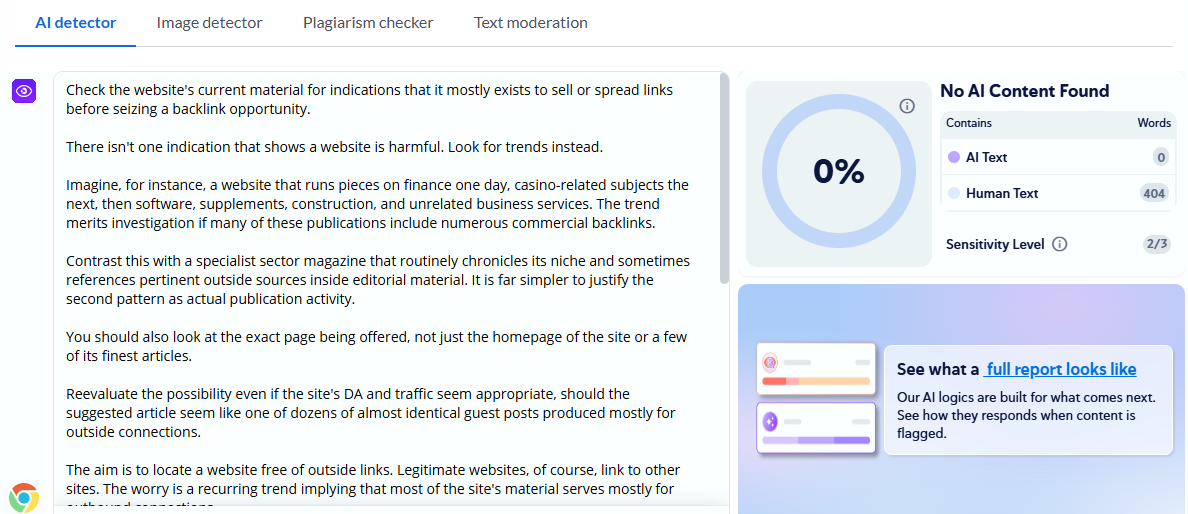
Quillbot:
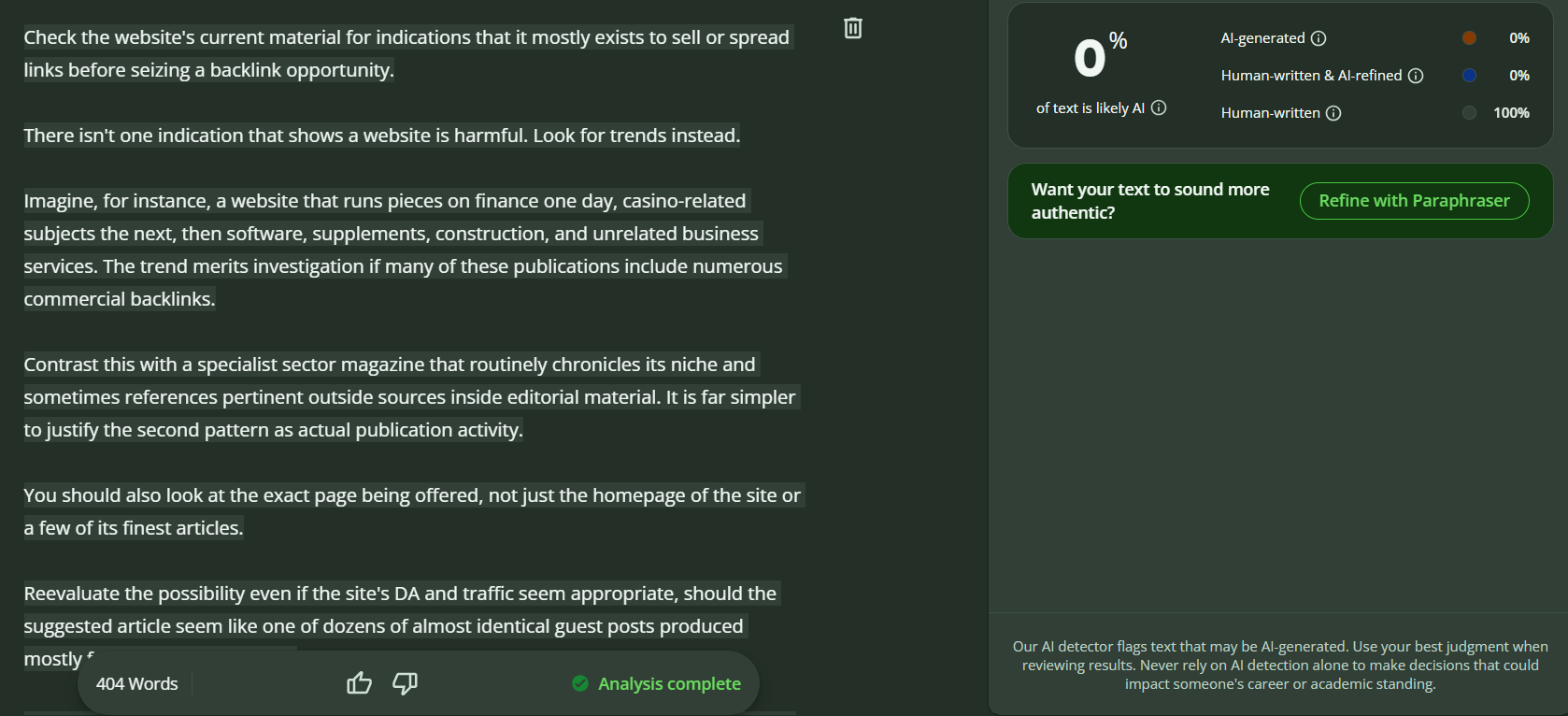
Even for the longer passage, the results were still the same. Not even a single fragment was flagged as AI.
The length of the humanized text was almost similar to the input. Nothing was cropped or overly explained. Still, for a long passage, you need to be mindful of a few things.
The humanizers often love variety of words a little too much. So, in a few places, you might need to adjust the key terms to target the precise SEO terminology.
Also, when humanizing long text, there’s always a chance of the output becoming a bit repetitive, so it would be wise to give it a thorough look and replace/remove the wording that adds little to no value. This may help make the final piece more direct and to the point.
Testing Summary
Here’s a summary of all three AI detection tests.
Test | Test Type | ZeroGPT | Copyleaks | Quillbot |
Test 1 | Blog style paragraph | 0% | 0% | 0% |
Test 2 | Academic paragraph | 0% | 0% | 0% |
Test 3 | Long informational passage | 0% | 0% | 0% |
So, Does ezHumanizer Really Make AI Text “Undetectable”?
Based on our testing, yes. We tried three different content types and scanned the tool’s output through three different detectors. Every single time, the content was marked as human-written.
But the term “undetectable” needs some context. Our tests show what happened with the three samples and the three detectors we used.
AI detection tools keep updating their models constantly. And no humanizer wins forever against every detector on every text.