Artificial intelligence, you know, has really shifted how students approach learning and a͏lso solving math problems. AI math solvers, these tools, they can actually break down equations, make tricky concepts easier to understand, and then give you step-by-step solutions in just a few seconds. However, this whole thing has brought up a significant question, really, for both students and the teachers: Is it possible for AI detectors to actually check solutions generated by AI?
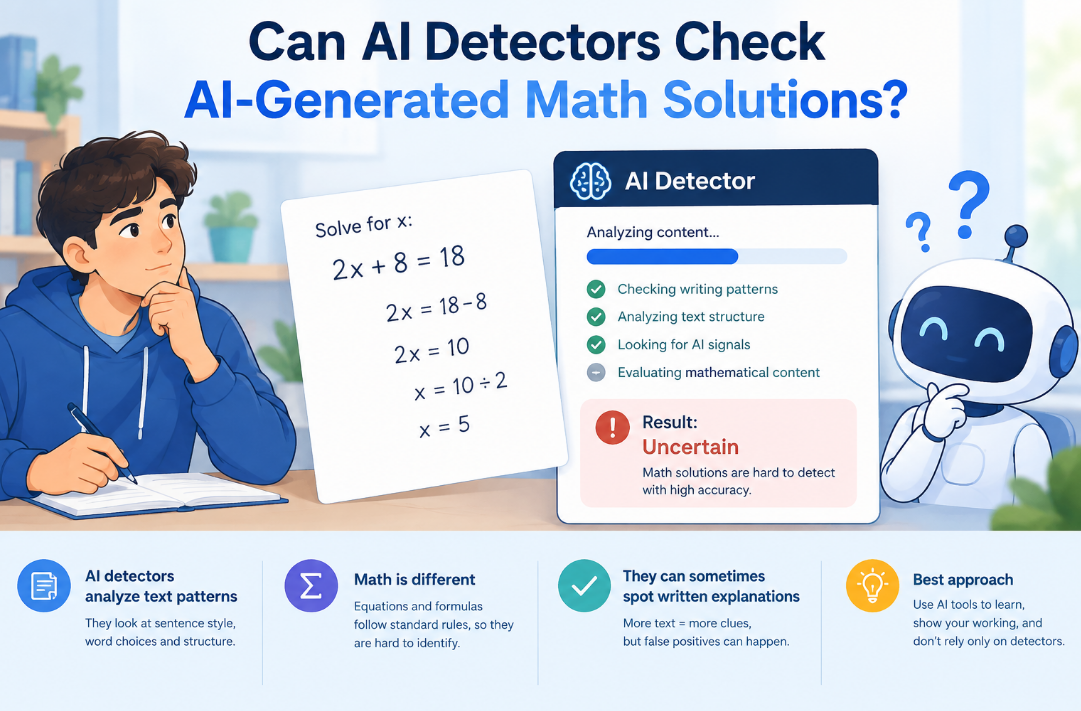
The brief answer to that is sometimes, though not always with reliability. Mostly, AI detectors are built to look at written language. But math solutions, they are usually full of equations, numbers, various symbols, and formulas, along with usually just very short explanations. And that, in effect, makes AI-generated math work much harder to spot accurately.
How AI Detectors Work
AI detectors generally examine patterns in text that may indicate that it was generated by an artificial intelligence system. They may analyze sentence structure, word choices, predictability, writing patterns, and other linguistic characteristics.
For example, if an AI produces a paragraph explaining how to solve a quadratic equation, an AI detector may analyze that paragraph. However, it is much harder for a detector to evaluate something like:
x² + 5x + 6 = 0
followed by:
(x + 2)(x + 3) = 0
x = -2 or -3
There is very little natural-language text for an AI detector to analyze.
Why Math Solutions Are Different
Mathematical answers are usually structured around logic rather than writing style. Many correct solutions can look almost identical regardless of who created them.
For example, different students solving:
2x + 8 = 18
will probably write:
2x = 10
x = 5
An AI-generated solution can look exactly the same. Because the answer follows standard mathematical rules, detecting whether it came from a student or an AI system can be extremely difficult.
This means an AI detector may have limited value when checking purely mathematical work.
What About Written Math Explanations.
AI detection actually becomes more possible if a math solution includes a lot of written explanation. For instance, an AI could write something like: “First, subtract 8 from both sides of the equation in order to isolate the variable.
Next, you divide both sides by 2. Therefore, the value of x is 5.” Here, the detector receives natural-language text it can analyze.
Although, even in this kind of situation, the result ought not to automatically be treated as proof artificial intelligence was used.
It is common knowledge that AI detectors can often produce false positives, and this means they might incorrectly identify content written by a human as something generated by AI.
Can AI Detectors Prove That a Student Used AI?
Generally, an AI detector should not be considered definitive proof by itself. A detector provides an estimate or prediction based on patterns in the submitted content.
This is especially important with math because formulas, standard terminology, and short explanations naturally have repetitive structures.
A teacher evaluating suspected AI-generated math work may also consider other evidence, such as:
The student's previous work
Their ability to explain the solution
Their calculation process
Drafts or working notes
Changes in writing style
Whether the student understands the mathematical concept
Looking at the complete learning process is usually more meaningful than relying on a single detection score.
Can AI Math Solvers Help Students Learn?
AI math solver can really be useful educational tools. This is when students use t͏hem responsibly. You see, instead of just copying an answer, studen͏ts have the option to use one of these AI math solvers to understand steps that might be difficult, or to check their calculations, explore different ways to solve a problem, or even find their mistakes.
For instance, say a student is having trouble understanding how to factor a quadratic equation. They can ask an AI tool to break down the process, step by step. Then, after that, the student can go on and solve other, similar problems on their own. This way, the AI acts like a learning assistant; it is not just some tool that spits out answers.
Final Thoughts
So, that b͏rings up another point: can AI detectors really check math solutions that we͏re made by AI? Well, sometimes they can analyze the written explanations that go along with a math solution. But, it is much harder to detect AI-generated mathematics when the work is mostly equations, just calculations, and standard formulas.
Therefore, AI detection tools should be looked at more as indicators, not as definite proof. For students, the best way to go about it is to really understand the math themselves, clearly show their working. And, importantly, use these AI tools to help with their learning process, not to replace their own thinking.