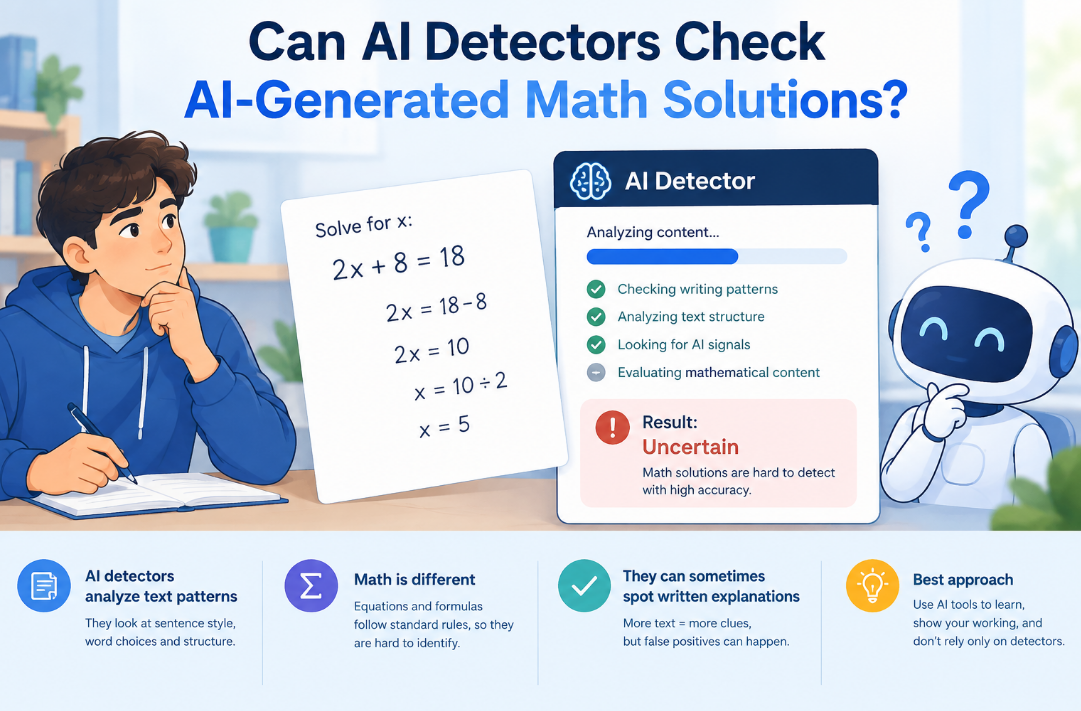

Sometimes, unreliably, and less well each year. That is the accurate answer, and the reasoning behind it says something useful about what detection actually measures — and about what neither side of this market tends to advertise.
What humanizers do
Most statistical detectors read the same family of signals. Language models produce text with unusually low perplexity, meaning each next word is more predictable on average than it would be from a human writer, and unusually low burstiness, meaning less variance in sentence length and structure than human prose typically shows.
Humanizers target those two properties directly. The operations are consistent across the category: synonym substitution, sentence splitting and merging, clause reordering, injection of lower-frequency vocabulary, and deliberate irregularity in rhythm. Perplexity rises, variance rises, the score falls.
That is the entire mechanism. It is an attack on a specific measurement, not a transformation of generated text into human writing — and the distinction turns out to matter more than the category's marketing suggests.
Why the effect degrades
Humanizing substitutes a signature rather than removing one. Rewriting at scale is a systematic process, and systematic processes leave systematic traces. Rewritten text tends toward synonym choices that are contextually valid but distributionally strange — the word a thesaurus would select rather than the word a writer would reach for. Sentence-length variance frequently becomes uniform in its irregularity, because it was produced to satisfy a target distribution rather than by someone thinking. Idiomatic collocations break in characteristic ways.
These traces are learnable. The classification problem shifts from "does this resemble model output" to "does this resemble anything other than unedited human writing" — a considerably easier question, and one where heavily rewritten text is not concealed.
Each tool is calibrated against a moving target. A humanizer tuned against the detectors of eighteen months ago is not tuned against current ones. Detection vendors retrain, rewriting vendors retune, and the cycle repeats. The practical consequence is invisible to the end user: the effectiveness they see reflects whenever the tool was last calibrated, not the detector they will actually encounter.
Entire categories of evidence are unaffected. Perplexity manipulation does nothing against:
Watermarking, where provenance is embedded during generation. Rewriting degrades some schemes and leaves others intact, and the writer has no way to know which applies.
Document metadata and revision history. A version log showing four thousand words arriving in three paste events is a record, not a statistical inference.
Stylometric comparison against known prior work. Where an institution holds a writer's earlier submissions, the question becomes whether a document matches how that specific person writes. Rewriting does not move text toward an individual's style; it moves text away from any consistent style, which under comparison is itself an anomaly.
Process evidence generally — drafts, notes, the ability to discuss one's own argument. This is the direction institutional practice is moving, and rewriting does not address it at any level.
Output quality typically suffers. Aggressive substitution damages precision, particularly in academic and technical writing where specific terms carry specific meaning. Rewritten text can score well while reading as incoherent to a subject-matter reader. A human grader reading for content is also a detector, and a considerably harder one to satisfy.
Two populations, one conversation
Discussion of this category tends to collapse two very different user groups into one, which distorts the picture in both directions.
The first group is the one everyone assumes: writers attempting to submit generated work as their own. For them, the honest assessment is that no rewriting tool can offer reliable protection, and any tool implying otherwise is selling a snapshot of a moving target. The risk profile is also asymmetric — failure surfaces at the point of highest consequence, and under most institutional codes, demonstrated use of an evasion tool is a materially worse finding than the underlying conduct.
The second group is less discussed and, by several operators' accounts, larger: writers whose own work has been flagged. False positives on second-language writing are well documented, and a writer who composed every word in their third language and received a high AI score faces a genuine problem with no clear remedy. They cannot prove a negative, and in most institutions no meaningful appeals process exists. Rewriting is a poor answer to that situation, but it is a comprehensible response to it — and unlike the first use case, it does not disappear as detection improves.
Treating these groups as a single population makes the false-positive problem harder to see, and it is the group least able to absorb the cost that gets obscured.
Implications for institutions
Three conclusions follow, none of which require trusting either vendor category:
A low score is not evidence of human authorship. If rewriting moves scores at all, then a clean result is uninformative in precisely the cases that matter. Detection is more defensible as a prompt to look closer than as a clearance.
Similar tools do not corroborate one another. Two detectors built on comparable statistical approaches will be defeated by comparable interventions. A second opinion adds information only when it reads a genuinely different signal — provenance, stylometry against known prior work, or process evidence.
Process evidence outperforms artifact analysis. Every signal in the untouchable list concerns how a document came into existence rather than what it looks like when finished. Assessment designed around drafts, revision history, and conversation is not only harder to evade — it measures something much closer to what institutions actually wanted to know.
The summary neither side likes
The rewriting category, including many AI humanizer tools that aim to make AI-generated content sound more natural and readable, sells certainty it cannot deliver. The detection category has at times sold precision it cannot deliver either. Both operate against the same underlying constraint: finished text is a weak carrier of authorship, and no amount of statistical machinery on either side changes that.
Humanizers can move a score. They cannot convert generated work into someone's own work, and institutional practice is steadily shifting toward evidence where that difference is visible. As characterizations unchecked - GPTZero's editors will know this material better than almost any other publisher you could pitch.